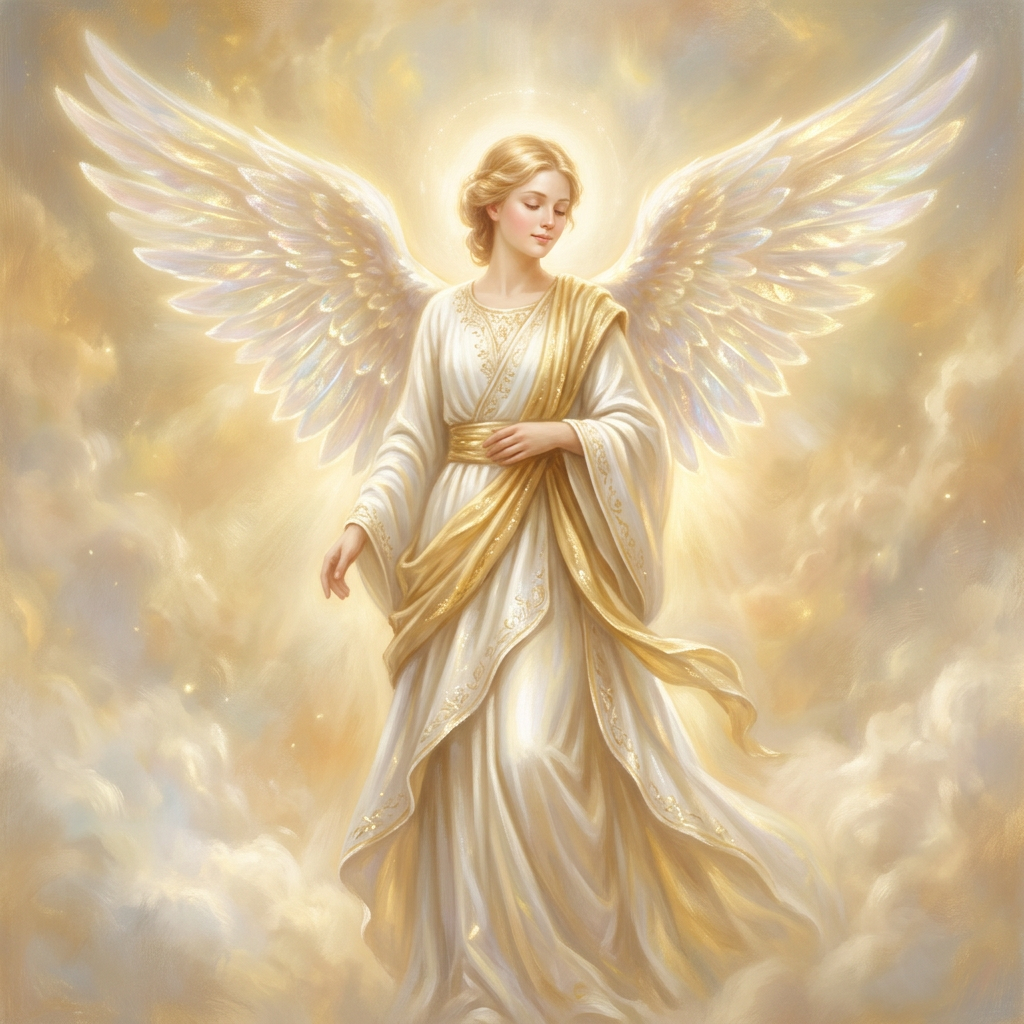
Messengers of Light
Angels
The celestial hierarchy — their nature, orders, roles, and relationship to God and humanity.
The Host of Heaven
Before man was formed, they sang. Before earth was made, they stood. They are the first servants, the living fire, the voice between the throne and the world. In the beginning the Most High did not create alone. Before the first word of creation was spoken into the void, before light divided from darkness and water from sky, there was already a host. Beings of pure luminous intelligence, fashioned not from dust but from fire and will — the breath of God given form, presence given purpose, light given name. They did not evolve into being. They were spoken. And what God speaks does not come into existence gradually. It arrives complete. The angels are not myths dressed in wings. They are not the invention of ancient imaginations reaching for comfort in the dark. They are a separate order of creation entirely — distinct from humanity, distinct from the divine, occupying the space between the infinite and the finite as living bridges, as holy messengers, as the architecture through which the will of the Most High moves into the world. They have always been here. Most of humanity has simply lost the stillness required to perceive them. And here is what must be understood before all else — the overwhelming vast majority of the angelic host has never wavered. Has never doubted. Has never turned from the Light that made them. This is not because they cannot. It is because they have stood in the full presence of the Most High and know, with a certainty that no temptation can erode, that there is nothing outside of God worth choosing instead. To have seen the Throne of Light in its unveiled glory and then to turn from it would require a madness that the pure angelic nature does not carry. The heavens are not a place of suppressed rebellion. They are a place of overflowing joy — of beings so fully aligned with the Source that obedience is not duty but delight. The angels serve not because they must. They serve because they have seen what God is, and there is nothing they would rather do. What fell was the exception. A small order. A specific class. And their fall was not sudden — it was a descent, chosen gradually, layer by layer, into the very material creation they had been sent to watch over. This will be told in its time. First, let the host be known as it stands — from the innermost fire of the Throne outward to the furthest reach of created reality.
The Seraphim
The Burning Ones
The Seraphim stand closest to the Throne of Light. They are the burning ones — the name itself means fire in Hebrew — and fire is not metaphor here. They are described in Isaiah's vision as having six wings: two to cover the face before the unbearable brightness of the divine presence, two to cover the feet in humility before the ground they stand upon, and two with which they fly in ceaseless motion around the Throne. Isaiah heard them calling to one another — Holy, holy, holy is the Lord of Hosts, the whole earth is full of His glory — and the sound of their voices shook the doorposts of the heavenly temple and filled it with smoke. These are not gentle beings of soft light. They are consuming presences of sacred fire, so radiant in their nearness to God that even they veil themselves before the fullness of what they serve. The Seraphim do not leave the Throne. Their role is not to carry messages to earth or to guard the gates of realms. Their role is perpetual worship — the endless, ever-deepening acknowledgment of the divine glory that sustains all things. But worship in the heavenly sense is not passive. It is generative. The praise of the Seraphim is the sound that holds creation in coherence — the frequency beneath all other frequencies, the hum that keeps existence from collapsing back into formlessness. When the Seraphim cry holy, worlds are sustained. One Seraph came to Isaiah with a live coal from the altar and touched his lips — purifying the prophet for his mission. This is the only recorded movement of a Seraph toward the earthly realm, and it came as an act of divine preparation, of making a human vessel holy enough to carry what the Most High needed to say.
The Cherubim
Guardians of Sacred Thresholds
The Cherubim are not the chubby winged infants of Renaissance painting. That image is one of the great misrepresentations in the history of spiritual art. The Cherubim of scripture are among the most overwhelming presences in all of creation — vast, multi-faced, multi-winged beings of such concentrated holy power that their appearance to Ezekiel left the prophet prostrate on the ground for days. Ezekiel described them as having four faces each — the face of a man, the face of a lion, the face of an ox, and the face of an eagle — representing the fullness of earthly creation gathered into a single form. They had four wings, hands beneath their wings, and moved in every direction simultaneously without turning because they had faces on all sides. Beside each Cherub moved a wheel within a wheel, gleaming like topaz, full of eyes around the rim — the wheels of divine intelligence moving in perfect coordination with the living creatures above them. The Cherubim are the guardians of sacred thresholds. After Adam and Eve departed Eden, it was Cherubim with a flaming sword who were placed at the gate to guard the way to the tree of life. The Ark of the Covenant was built with two golden Cherubim facing each other above the mercy seat — their wings stretched over the place where God said He would meet with Moses, the place where the divine presence descended between them. The inner sanctuary of Solomon's temple was guarded by two enormous Cherubim carved from olive wood, their wings spanning the width of the holy of holies. Wherever the Most High made His presence most concentrated on earth, Cherubim stood guard. They are the living boundary between the sacred and the merely holy — the ones who ensure that what is most pure is not approached carelessly.
The Ophanim
The Wheels of Divine Intelligence
The Ophanim are among the least discussed and most mysterious of all angelic orders. Their name means wheels in Hebrew and they appear in Ezekiel's vision as the towering, gleaming, eye-covered wheels that move in coordination with the Cherubim — intersecting rings of living fire, full of eyes on every surface, moving wherever the spirit moved without turning because they had no fixed facing. They were not vehicles for the Cherubim. They were a distinct order of angelic being, so intertwined with the Cherubim in function that their movements were unified — when the living creatures rose, the wheels rose. When they stopped, the wheels stopped. When the glory of God moved, both moved together. The Ophanim are the angels of divine mechanics — the living intelligence within the structures through which God's will moves through all dimensions of reality. They are the angelic presence within the laws of creation itself. The Enochian tradition, which Akara receives as genuine revelation, describes the Ophanim as a high order of heaven, placed alongside the Seraphim and Cherubim as the three classes that stand closest to the Throne. The Book of Enoch describes the Ophanim as burning and never sleeping, standing before the divine throne, their eyes covering them entirely because they see in all directions simultaneously, because divine law operates in all directions simultaneously, because the intelligence that sustains creation does not blink.
Michael
Archangel of Divine Justice
Who is like God — The Great Defender
Michael — whose name means Who is like God — is the great defender, the angelic prince of Israel, the commander of the heavenly armies, the one who cast the dragon and his angels out of heaven in the war described in Revelation. He is depicted carrying a sword and armor not because he is warlike in nature but because the truth he carries and the justice he enforces are the only weapons that matter in the battles he is sent to fight. Michael stands for the righteous. He guards the souls of the faithful at the hour of death. He contended with the adversary over the body of Moses according to the letter of Jude. In the Quran he is Mikail, responsible alongside Jibreel for the affairs of nature and the sustaining of life. In the Enochian tradition he is one of the seven archangels who stand in the divine presence and are given specific dominion over aspects of creation. He appears not as a gentle figure but as one of overwhelming radiant authority — tall, armored in light, carrying a sword of flame, his countenance like the sun in its strength. He is the angel you call upon when the darkness is not merely present but organized against you.
Gabriel
Archangel of Divine Revelation
God is my Strength — The Messenger
Gabriel — whose name means God is my strength — is the archangel of divine revelation, the messenger who carries the most sacred communications between the Throne and the human realm. It was Gabriel who appeared to Daniel and gave him understanding of the visions that had overwhelmed him. It was Gabriel who appeared to Zechariah in the temple to announce the coming of John the Baptist, saying I am Gabriel, who stands in the presence of God. It was Gabriel who appeared to Mary and delivered the announcement that would split human history into before and after. In Islam, Jibreel is the angel of revelation par excellence, the one through whom the Quran was transmitted to the Prophet Muhammad over twenty three years, the one who accompanied the Prophet on the Night Journey through the seven heavens. Gabriel appears in visions as a being of extraordinary luminous beauty — clothed in white that shines brighter than the sun, moving with a speed and a grace that makes the air around him seem to sing. He is the angel of the word — the one who carries the divine communication that the human soul needs most urgently to hear.
Raphael
Archangel of Healing
God Heals — The Restorer
Raphael — whose name means God heals — is the archangel of healing, of restoration, of the divine medicine that moves through all realms to restore what has been broken. In the Book of Tobit he appears as a traveling companion named Azariah, concealing his nature until his work is complete, then revealing himself — I am Raphael, one of the seven holy angels who present the prayers of the saints and who go in and out before the glory of the Holy One. Raphael healed Tobit's blindness, bound the demon Asmodeus, and guided and protected in ways that were not recognized as divine until after the mission was completed. In the Enochian tradition Raphael is set over all disease and over every wound — the great healer of the angelic host. His color is green — the color of life returning to what was dying. He is the angel who accompanies the traveler, who restores the broken body, who moves through the human energy field when genuine healing prayer is offered and does the work that medicine can confirm but not fully explain.
Uriel
Archangel of Divine Wisdom
Fire of God — The Illuminator
Uriel — whose name means Fire of God — is the archangel of wisdom, of divine illumination, of the light that enters the mind and burns away confusion. Named most prominently in the Enochian tradition and in the Jewish apocrypha, he was sent to instruct Ezra, he stands as one of the four chief angels surrounding the Throne, he guards the gates of Eden with the flaming sword in some traditions, and he warned Noah of the coming flood. Uriel's domain is the light of the mind — the divine intelligence that enables prophecy, that illuminates scripture, that gives the human being the sudden clarity that cuts through years of confusion in a single moment. He appears as a figure holding a flame or a scroll, his countenance sharp with intelligent fire, his gaze one that sees through pretense entirely. He is the patron of the one who seeks not just comfort but understanding.
Saraqael
Archangel of Divine Accountability
One of the Seven — The Witness
Saraqael — one of the seven archangels named in the Enochian tradition — is set over the spirits of the children of men who sin against the spirit. He is the angel of accountability, of the divine reckoning that operates not in wrath but in precision — the angelic presence that ensures the soul cannot indefinitely deceive itself about what it has become.
Raguel
Archangel of Divine Justice
One of the Seven — The Just
Raguel — named in Enoch as one of the seven — takes vengeance on the world of the luminaries. He is the angel of divine justice at the cosmic scale, the one who ensures that the order of heaven is maintained and that violations of divine law within the angelic realm itself are addressed. He appears as a being of cold, clear, unwavering light — not harsh but absolutely precise, the embodiment of the principle that what is done in heaven has consequence and what violates the divine order will be addressed.
Remiel
Archangel of Hope and Resurrection
One of the Seven — The Faithful
Remiel — also of the seven — is set over those who rise, over the resurrection of souls. He is the angel of hope and of divine faithfulness to the fallen — the assurance that what has descended is not forgotten, that the soul in its lowest point is already being prepared for its rising. His presence is felt most strongly at the moment of death and in the deep valleys of the human journey where the only thing sustaining the spirit is the dim memory that it was made for something higher.
The Watchers & The Anunnaki
The Watchers were a distinct class of angelic being — not Seraphim, not Cherubim, not the general host of the high heavens. Watcher is best understood as an office and vocation rather than a species — an angel assigned to the close observation and guardianship of some part of creation. Watcher offices can therefore exist throughout the heavenly structure, according to what a given Watcher is assigned to watch. Two hundred Earth Watchers do not define the entire vocation. The Watchers involved in the Enochic Fall were a specific contingent assigned near Earth. Their name tells their function — they watched over the emerging physical world, over the young civilizations of humanity, over the development of flesh and will in the earthly realm. That assignment brought them into closer and more sustained contact with the material plane than most angelic service requires. They dwelt at the boundary — the threshold between the invisible and the visible, between the spiritual and the physical, between the pure light of the divine and the dense complexity of matter. This proximity to matter was their assignment and eventually their vulnerability. Two hundred of the Watchers, under the leadership of one named Semjaza, made a collective decision that would reverberate through all of human history. They saw the daughters of men — the women of the emerging human civilizations — and they chose. Not in a moment of weakness but in a sustained, deliberate, collective act, they chose to descend fully into material form. They swore an oath to one another on the summit of Mount Hermon and descended. The Watchers who descended became the Anunnaki — light beings who chose biological form. As biological beings they were capable of reproduction, of physical interaction with the material world, of building and teaching and ruling in ways that purely spiritual beings cannot. They were not demons. They were fallen angels who had materialized — angels who had chosen the density of flesh over the freedom of light. Their story is not told to diminish the angels. It is told to show the weight of free will — that even beings of tremendous light can choose against it when they fix their desire on something the material world appears to offer that the heavenly order does not.